


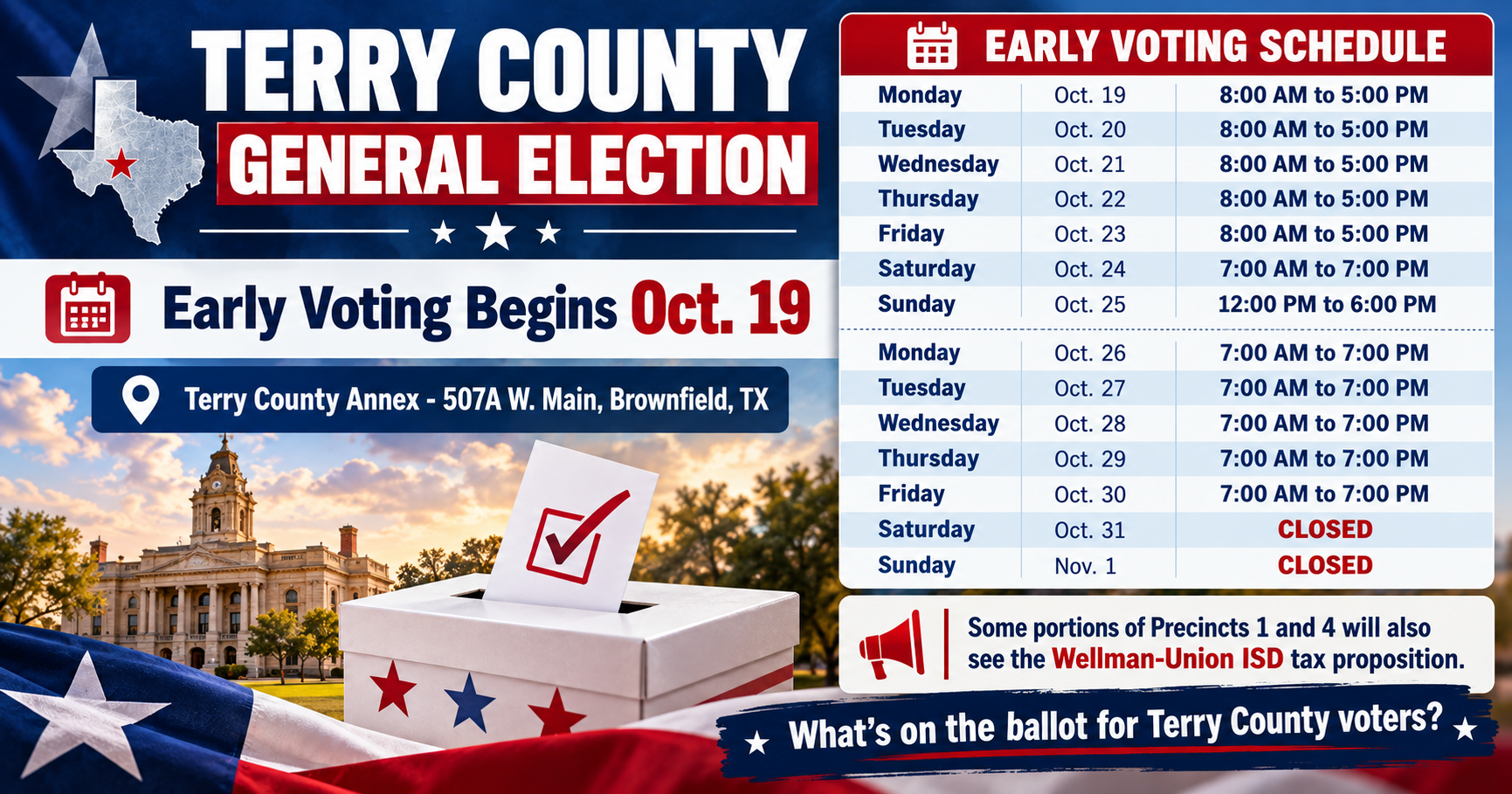
Early voting for the November 3, 2026 General Election begins tomorrow, Monday, October 19, across Texas, giving Terry County voters their first opportunity to cast ballots in a wide-ranging election featuring federal, statewide, judicial and local races.
Early voting will continue through Friday, October 30. In Terry County, early voting will take place at the Terry County Annex, 507A W. Main Street in Brownfield.
This year’s ballot gives voters a voice in races that will help shape representation in Washington, Austin and right here at home. Whether a race receives national attention or involves a local office, every ballot is part of the final result. Close elections can be decided by relatively small margins, and local contests can have an especially direct impact on a community. Voting is one of the most basic ways citizens participate in deciding who represents them and how public policy moves forward.
The 2026 ballot includes major races for U.S. Senate, U.S. House District 19, Governor, Lieutenant Governor, Attorney General and other statewide offices. Terry County voters will also consider state judicial races, legislative contests and several county offices. Portions of Precincts 1 and 4 within the Wellman-Union Independent School District will also vote on a voter-approval tax-rate proposition.
Federal Races
U.S. Senate: Ken Paxton, James Talarico and Ted Brown
The race for United States Senate has developed into one of the most closely watched contests on the Texas ballot. Republican Ken Paxton, Democrat James Talarico and Libertarian Ted Brown are competing for the seat, and recent public polling has shown Paxton and Talarico running within only a few percentage points of one another. An October University of Texas/Texas Politics Project poll had Talarico at 50% and Paxton at 47% among likely voters, while other recent surveys have produced similarly narrow margins in both directions. With most of those differences falling within or near the surveys’ margins of error, the polling suggests a competitive race rather than a clear leader.
Paxton enters the race after more than a decade as Texas attorney general and previously served in both the Texas House and Texas Senate. His campaign has emphasized immigration enforcement, conservative social policies and his record of challenging federal policies through the courts. Talarico, a state representative and former public-school teacher, has focused heavily on public education, health care, the cost of living and what he describes as the need for a different style of political leadership. Brown provides a Libertarian alternative for voters who do not identify with either major party. The race is receiving particular attention because Texas has not elected a Democrat to the U.S. Senate since 1988, while Republicans are seeking to hold a seat that has remained reliably in their column for decades.
U.S. House District 19: Tom Sell and Kyle Rable
In U.S. House District 19, Republican Tom Sell faces Democrat Kyle Rable for the open congressional seat being vacated by Rep. Jodey Arrington. The sprawling district includes much of the South Plains and West Texas, stretching from the Lubbock area toward Abilene, and its economy is closely tied to agriculture, energy production and rural communities.
Sell, a Lubbock businessman and former congressional staff member, has made his background in agricultural policy a centerpiece of his campaign. He previously worked for former Congressman Larry Combest and served as deputy staff director for the House Agriculture Committee, giving him direct experience with federal farm policy. Sell has emphasized agriculture, energy, limited government and conservative priorities while arguing that his experience would allow him to begin working on West Texas issues immediately.
Rable, a Lubbock resident, Army Reserve member and doctoral student at Texas Tech University, has focused his campaign on rural economic pressures, struggling family farms, health care and the rising cost of everyday necessities. He has argued that both parties have sometimes taken West Texas communities for granted and has called for policies aimed at strengthening small farms and protecting programs such as Medicare, Medicaid, Social Security and veterans’ services.
The district has historically been strongly Republican, making the political environment different from several of the closely contested statewide races. However, the election still gives District 19 voters their first opportunity in years to choose a new representative rather than decide whether to return an incumbent to Congress.
Statewide Races
Governor: Greg Abbott, Gina Hinojosa and Pat Dixon
The race for governor has also become considerably more competitive than many Texas gubernatorial contests in recent years. Republican Gov. Greg Abbott is seeking a fourth term against Democratic state Rep. Gina Hinojosa and Libertarian Pat Dixon. Recent polling has generally placed Abbott and Hinojosa only a few points apart. One October polling average placed Abbott at 48.7% and Hinojosa at 46.4%, while individual surveys have alternately shown Abbott narrowly ahead or Hinojosa holding a small advantage. Because several of those margins fall within the polls’ margins of error, the results point to a close contest rather than establishing a definitive leader.
Education has emerged as one of the sharpest dividing lines in the race. Abbott has made school choice a signature issue of his administration and continues to defend the state’s new voucher program, while also emphasizing teacher accountability, classroom standards and efforts to attract and retain educators. Hinojosa has pledged to reverse several Abbott education policies, including eliminating the voucher program, changing the state’s school accountability approach and increasing support for public schools and teachers.
There are signs that organized educator groups are lining up behind Hinojosa. The Texas State Teachers Association has endorsed her, and the Texas American Federation of Teachers is also among her supporters. That should not be interpreted to mean Texas educators as a whole are moving toward the Democratic candidate; there is no statewide vote count showing how teachers will cast their ballots. It does, however, indicate that public-school policy could be an important factor among educators and other voters closely connected to public education.
Railroad Commissioner: Bo French, Jon Rosenthal and Arthur DiBianca
Republican Bo French, Democrat Jon Rosenthal and Libertarian Arthur DiBianca are competing for a seat on the Texas Railroad Commission. Despite its name, the commission does not regulate railroads; it is one of the most important energy regulatory bodies in the state, overseeing oil and gas production, pipelines and other parts of Texas’ energy infrastructure.
The race has drawn considerably more attention than Railroad Commission elections typically receive because of controversy surrounding French’s social-media comments. In September, French posted a photograph showing a group of mostly South Asian students attending a University of Texas football game and wrote that the image demonstrated how many Americans had been “displaced by foreigners.” French did not know the immigration or citizenship status of the students pictured, and at least some of the students later said they were U.S. citizens. State law requires 90% of each incoming undergraduate class at UT Austin to consist of Texas residents, and international students represented about 4% of the university’s undergraduate enrollment during the 2025-26 school year.
The comments generated criticism from Democrats as well as prominent Republicans, including U.S. Sen. John Cornyn. French defended the broader argument behind his post, saying his concern was whether universities and other institutions should prioritize Americans over foreign nationals. The controversy has consequently moved immigration, university admissions and French’s political style into a contest that ordinarily would concentrate almost entirely on oil and gas regulation.
Rosenthal has sought to keep the focus on the commission’s regulatory responsibilities. A mechanical engineer and state representative from the Houston area, he has emphasized his decades of experience in the oil and gas industry and argues that technical knowledge of the energy sector is important for the commission. French, meanwhile, has campaigned as a conservative challenger to what he sees as establishment control of state government and defeated incumbent Commissioner Jim Wright in the Republican primary runoff.
There is also an unusual debate angle to this race. As of October 18, the Railroad Commission contest is the only statewide Texas race with a confirmed debate on the calendar. French and Rosenthal are scheduled to meet October 22 in Dallas. Most other Republican nominees for statewide office — including Abbott and Paxton — have not agreed to debates with their Democratic opponents. It would therefore be more accurate at this point to say French is the only Republican statewide nominee scheduled to debate his Democratic opponent, rather than saying he has already done so.
Polling also suggests the traditionally lower-profile Railroad Commission race deserves some attention this year. The October UT/Texas Politics Project survey had Rosenthal at 47% and French at 46%, with Libertarian Arthur DiBianca and other responses making up the remainder. That one-point difference was within the poll’s margin of error, meaning the survey did not establish a statistically clear leader.
These four races give the story a stronger centerpiece because each represents a different political dynamic heading into early voting: an unusually competitive U.S. Senate contest, an open congressional seat important to West Texas, a governor’s race in which education has become a major dividing issue, and a normally quiet Railroad Commission election that has been pushed into the statewide spotlight by controversy and an upcoming debate.
The Lieutenant Governor’s race includes Republican Dan Patrick, Democrat Vikki Goodwin, Libertarian Anthony Cristo and Green Party candidate Kevin McCormick.
For Attorney General, voters will choose among Republican Mayes Middleton, Democrat Nathan Johnson and Libertarian Tom Oxford.
The Comptroller of Public Accounts race includes Republican Don Huffines, Democrat Sarah Eckhardt, Libertarian V. Alonzo Echavarria-Garza and Green Party candidate Shehla Faizi.
Commissioner of the General Land Office candidates are Republican Dawn Buckingham, Democrat Benjamin Flores and Libertarian Neill Snider.
The race for Texas Agriculture Commissioner includes Republican Nate Sheets, Democrat Clayton Tucker and Libertarian Austin R. Kelly.
Texas Courts
Several Texas Supreme Court positions are on the ballot, including Chief Justice, where Republican Jimmy Blacklock faces Democrat Maggie Ellis.
Other Supreme Court contests include Place 2, Republican James P. Sullivan against Democrat Chaz Kelly; Place 7, Republican Kyle Hawkins against Democrat Kristen Hawkins; and Place 8, Republican Brett Busby against Democrat Gisela D. Triana.
For Judge of the Court of Criminal Appeals, Place 3, Republican Thomas Smith faces Democrat Okey Anyiam and Libertarian Mark Ash. Place 4 features Republican Kevin Patrick Yeary and Democrat Audra Riley, while Place 9 includes Republican John Messinger and Democrat Holly Taylor.
Terry County voters will also see races for the 15th Court of Appeals. Republican Scott Brister faces Democrat Jerry Zimmerer for Chief Justice. Republican Scott K. Field faces Democrat Tom Baker for Place 2, while Republican April Farris faces Democrat Marc M. Meyer for Place 3.
Republican Judy Parker is unopposed for Chief Justice of the 7th Court of Appeals District, while Republican Laura Pratt is unopposed for the unexpired Place 2 term.
State Legislative Races
In Texas Senate District 28, Republican Charles Perry faces Democrat Riley Rodriguez.
Texas House District 83 features Republican Dustin Burrows against Democrat Malik Williams.
Terry County Races
Several Terry County offices feature Republican candidates running unopposed in the General Election.
Tony Serbantez is on the ballot for County Judge, Tiffany S. O’Briant for District Clerk, Nancy Gonzales for County Clerk, Jaclyn Morin for the unexpired term as County Tax Assessor-Collector, Andrea Perry for County Treasurer and Angie P. Garza for Justice of the Peace.
Terry County Commissioner Precinct 2 incumbent Richard Cavazos is also running unopposed and will appear on the ballot.
Republican nominee Elvis Rodriguez is running unopposed for Terry County Commissioner Precinct 4 and will appear on ballots for voters in that precinct.
Wellman-Union ISD Tax-Rate Election
Some voters in portions of Terry County Precincts 1 and 4 will have an additional decision to make involving Wellman-Union ISD.
The voter-approval tax-rate election asks voters whether to ratify an ad valorem tax rate of $1.61510 for the current year. According to the ballot language, the proposed rate represents a tax increase and would increase maintenance and operations tax revenue by 13.73 percent compared with the preceding year, totaling an additional $121,283.
Affected voters will have the option to vote “For” or “Against” the proposition.
Early Voting Schedule in Terry County
Early voting will be held at the Terry County Annex, 507A W. Main Street in Brownfield.
October 19–23: 8:00 a.m.–5:00 p.m.
Saturday, October 24: 7:00 a.m.–7:00 p.m.
Sunday, October 25: 12:00 p.m.–6:00 p.m.
October 26–30: 7:00 a.m.–7:00 p.m.
Election Day is Tuesday, November 3, 2026. Statewide, the early voting period runs from October 19 through October 30.
With decisions ranging from the U.S. Senate and Governor’s office to county government and a local school tax-rate proposition, Terry County voters have plenty to consider. Taking time to review the ballot before voting can help voters make informed choices, and beginning Monday, Texans will have nearly two weeks to make their voices heard before Election Day.
