


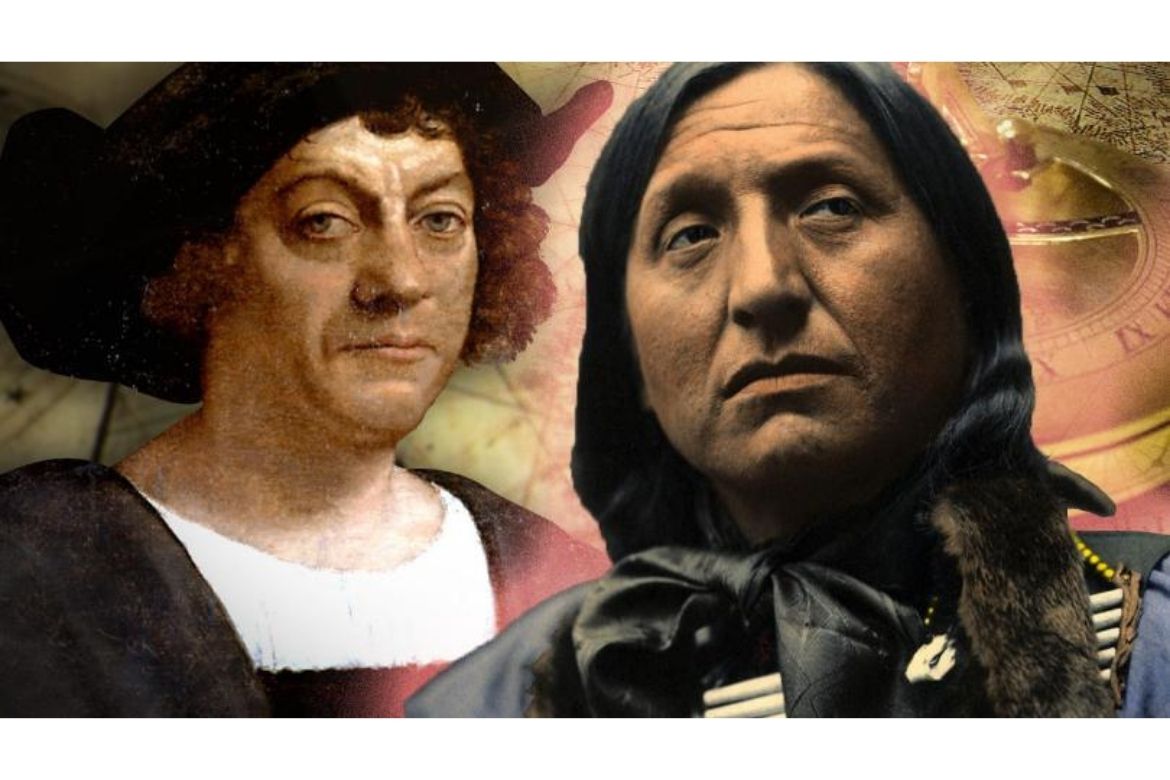
From: The History Channel
Columbus Day is a U.S. holiday that commemorates the landing of Christopher Columbus in the Americas in 1492, and Columbus Day 2021 occurs on Monday, October 11. It was unofficially celebrated in a number of cities and states as early as the 18th century, but did not become a federal holiday until 1937. For many, the holiday is a way of both honoring Columbus’ achievements and celebrating Italian-American heritage. But throughout its history, Columbus Day and the man who inspired it have generated controversy, and many alternatives to the holiday have proposed since the 1970s including Indigenous Peoples’ Day, now celebrated in many U.S. states and cities.
Christopher Columbus
Christopher Columbus was an Italian-born explorer who set sail in August 1492, bound for Asia with backing from the Spanish monarchs King Ferdinand and Queen Isabella aboard the ships the Nina, the Pinta and the Santa Maria.
Columbus intended to chart a western sea route to China, India and the fabled gold and spice islands of Asia. Instead, on October 12, 1492, he landed in the Bahamas, becoming the first European to explore the Americas since the Vikings established colonies in Greenland and Newfoundland during the 10th century.
Did you know? Contrary to popular belief, most educated Europeans in Columbus’ day understood that the world was round, but they did not yet know that the Pacific Ocean existed. As a result, Columbus and his contemporaries assumed that only the Atlantic lay between Europe and the riches of the East Indies.
Later that October, Columbus sighted Cuba and believed it was mainland China; in December the expedition found Hispaniola, which he thought might be Japan. There, he established Spain’s first colony in the Americas with 39 of his men.
In March 1493, Columbus returned to Spain in triumph, bearing gold, spices and “Indian” captives. The explorer crossed the Atlantic several more times before his death in 1506.
It wasn’t until his third journey that Columbus finally realized he hadn’t reached Asia but instead had stumbled upon a continent previously unknown to Europeans.
Columbus Day in the United States
The first Columbus Day celebration took place in 1792, when New York’s Columbian Order—better known as Tammany Hall—held an event to commemorate the historic landing’s 300th anniversary. Taking pride in Columbus’ birthplace and faith, Italian and Catholic communities in various parts of the country began organizing annual religious ceremonies and parades in his honor.
In 1892, President Benjamin Harrison issued a proclamation encouraging Americans to mark the 400th anniversary of Columbus’ voyage with patriotic festivities, writing, “On that day let the people, so far as possible, cease from toil and devote themselves to such exercises as may best express honor to the discoverer and their appreciation of the great achievements of the four completed centuries of American life.”
What Is Indigenous Peoples’ Day?
Since 1991, dozens of cities, several universities, and a growing number of states have adopted Indigenous Peoples’ Day, a holiday that celebrates the history and contributions of Native Americans.
Not by coincidence, the occasion usually falls on Columbus Day, the second Monday in October, or replaces the holiday entirely. As of 2021, the holiday is observed or honored by states including Virginia, Maine, New Mexico, Vermont, Alaska, Hawaii, Oregon, Iowa, Louisiana, Michigan, Minnesota, North Carolina, Wisconsin, as well as South Dakota, which celebrates Native Americans’ Day, Hawaii, which celebrates Discoverers’ Day, and Alabama, which celebrates American Indian Heritage Day.
In 2021, President Biden became the first-ever president to issue a proclamation on Indigenous Peoples’ Day, writing, “Today, we recognize Indigenous peoples’ resilience and strength as well as the immeasurable positive impact that they have made on every aspect of American society.”
Why replace Columbus Day with Indigenous Peoples’ Day? Activists have long argued that holidays, statues, and other memorials to Columbus sanitize his actions—which include the enslavement of Native Americans—while giving him credit for “discovering” a place where people already lived.
“Columbus Day is not just a holiday, it represents the violent history of colonization in the Western hemisphere,” says Leo Killsback, a professor of American Indian Studies at Arizona State University.
During the late 19th and early 20th century, members of the stigmatized ethnic and religious group successfully campaigned to establish a Columbus Day in order to place Catholic Italians, like Christopher Columbus, into American history. In doing so, they edged out people of Anglo-Saxon descent who wanted a federal holiday honoring Leif Erikson as the first European to reach the Americas.


