


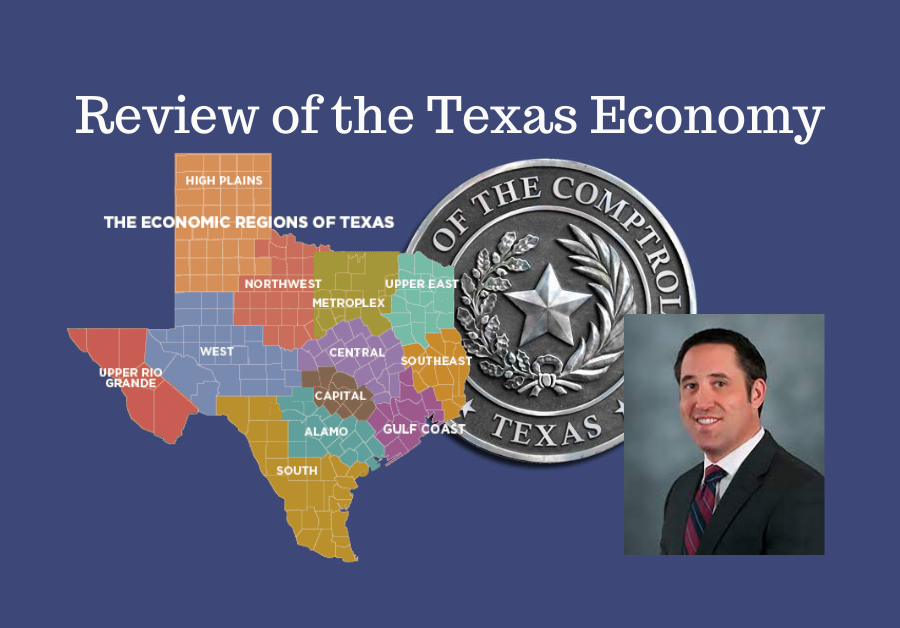
The Texas economy added 726,900 nonfarm jobs from August 2021 to August 2022, an increase of 5.7 percent, to reach 13,530,100 at the end of fiscal 2022. Texas added more new jobs than any other state over those 12 months. Private-sector employment rose by 6.6 percent while government employment (federal, state, and local) grew by 0.5 percent. The state’s rate of job growth was the highest among all 50 states.
Consumer Spending
Consumer spending is a significant component of the Texas economy. In fiscal 2016, for the first time since 2010, state sales tax collections fell (by 2.3 percent) from the previous year’s total. The decline in state sales tax revenue was led by reduced collections from the oil and natural gas-related exploration and production sectors, but collections from the manufacturing, retail trade, information, and real estate sectors also were down compared to 2015. Growth in sales tax collections resumed in 2017, with revenue up 2.3 percent over 2016. Sales tax revenue was up again in 2018, by 10.5 percent and by another 6.5 percent in 2019 to reach $34.0 billion. Despite economic disruptions resulting from the COVID-19 virus, 2020 sales tax collections managed a further increase of 0.2 percent from 2019, as increases in collections from the retail trade sector outweighed reduced collections from other sectors. Fiscal 2021 sales tax collections were up 5.6 percent from 2020 collections, with growth accelerating in the final three months of the fiscal year and continuing through fiscal 2022. Total sales tax collections increased by 19.3 percent over 2021 levels, with particularly strong growth in mining industry collections (up 103.2 percent).
The Consumer Confidence Index is a monthly measure of consumer optimism, an important factor affecting housing sales, automobiles, and other major purchases. The index for the four-state West South Central (WSC) Region, which includes Texas, was down by 17.5 percent in fiscal 2022. The index for the nation as a whole was down 10.4 percent.

Texas Industry Performance
Employment in the goods-producing industries increased by 7.8 percent in fiscal 2022, while employment in the service-providing industries grew by 5.3 percent. Employment increased in all three of the goods-producing industries (mining and logging, manufacturing, and construction), led by a 21.1 percent gain in mining and logging. All of the service-providing industries also saw year-over-year growth in employment, with the largest percentage gains in the information (11.0 percent) and leisure and hospitality (10.1 percent) industries.
Mining and Logging
Mining industry employment peaked in December 2014 at 321,900 and then declined steadily, reaching a low of 204,200 in September 2016. Industry employment then grew consistently for more than two years to reach 255,500 in January 2019. Industry employment fell sharply in fiscal 2020, but began to recover in the early months of fiscal 2021 and has increased consistently since then. August 2022 mining employment was up by 21.1 percent (38,100) from the August 2021 level, but at 219,000 was still 14.3 percent below the January 2019 peak.
Manufacturing
The Texas manufacturing industry gained 51,000 jobs over the past year, an increase of 5.8 percent. Durable goods employment was up 30,300, with the largest increase in the fabricated metals manufacturing sector (15,700, 13.3 percent). That sector is closely associated with oil and natural gas exploration and production, and employment in the sector has been increasing along with that in the mining.industry. Overall, durable goods employment increased by 5.5 percent. Nondurable-goods manufacturing employment grew by 20,700 (6.4 percent), with the largest increase in the food manufacturing sector (9,600, 9.4 percent). Total manufacturing employment in August 2022 was 927,700. The value of Texas exports in calendar year 2014 was a record $289 billion, an increase of 3.3 percent from 2013. Those exports provided a substantial boost to manufacturing, notably for companies producing chemicals, computers and electronics, petroleum products, industrial machinery and transportation equipment. In 2015, the value of Texas exports fell sharply (to $251 billion, down 13.1 percent), hurt by falling oil prices and a stronger dollar. Texas exports continued to fall in 2016, down another 7.4 percent. However, Texas 2017 exports were up 13.5 percent from the 2016 level and increased by another 19.4 percent in 2018. Total 2019 exports were 4.8 percent higher than 2018 exports; however, in November 2019, Texas exports decreased on a year-over-year basis. As a result of the COVID-19 pandemic and a fall in oil prices, exports fell sharply in 2020, down 15.5 percent from 2019 (to $279 billion). Export growth resumed in 2021, up 34.4 percent from 2020 and reaching a new high of $375 billion. Through July, Texas exports are up a further 39 percent from the corresponding period of 2021. Texas remains the nation’s leading exporting state, as it has been for more than a decade. Texas exports comprised 20 percent of total U.S. exports in 2021.

Construction
Construction employment increased by 50,000 (6.8 percent) in fiscal 2022 to reach 785,700 in August 2022. Employment in the construction of buildings sector increased by 2.6 percent (4,100) and heavy and civil engineering construction employment grew by 13.1 percent (20,600).
Total housing construction activity in 2022 was up from 2021. While single-family building permits issued in the year ending in July 2022, at 172,566, were down 0.7 percent from the same period one year earlier, building permits for multi-family units were up significantly (by 29.5 percent to 99,445). According to Multiple Listing Service data from the Texas A&M Real Estate Center, the median sales price for an existing Texas single-family home rose by 12.9 percent over the past year, from $310,000 in July 2021 to $350,000 in July 2022. In July 2022, Texas had a 2.4-month inventory of existing homes for sale, up from a 1.6-month inventory in July of 2021.
Professional and Business Services
Employment in the professional and business services industry increased by 122,600 (6.4 percent) in fiscal 2022. Employment changes varied considerably among industry sectors, with the largest increases in services to buildings and dwellings (10.4 percent) and employment services (12.6 percent). Total professional and business services employment was 2,035,100 in August 2022.
Education and Health Services
The education and health services industry, composed of the educational services and health care and social assistance sectors, gained 88,300 jobs in fiscal 2022, an increase of 5.1 percent. The relatively small educational services sector saw an increase of 33,500 jobs (15.1 percent). Employment in the much larger health care and social assistance sector grew by 3.6 percent (54,800 jobs). In all, Texas education and health services employment increased to 1,828,700 in August 2022.
Financial Activities
In fiscal 2022 overall employment in the financial activities industry grew by 7.5 percent (63,200 jobs). The finance and insurance sector grew by 24,700 (4.0 percent) while the real estate and rental and leasing sector grew by 38,500 (16.9 percent). Credit intermediation (which includes financial institutions such as banks) is the industry’s largest sector, employing 289,400 as of August 2022. Total Texas financial activities industry employment reached 901,700 in that month.
Trade, Transportation, and Utilities
The trade, transportation, and utilities industry, the state’s largest employer with 20 percent of total nonfarm jobs in August 2022, gained 118,900 jobs (4.6 percent) over the year. Employment in all three industry sectors — retail trade, wholesale trade and transportation, warehousing, and utilities — increased during fiscal 2022. Wholesale trade employment was up 5.8 percent (34,700); transportation, warehousing, and utilities employment grew by 40,900 (6.4 percent); and employment in the retail trade sector increased by 43,300 (3.2 percent). In all, the trade, transportation, and utilities industry provided 2,700,900 Texas jobs in August 2022.

Information
The information industry is a collection of diverse sectors, representing established sectors of the economy (newspaper publishing, data processing, television broadcasting, and wired telephone services) as well as some newer sectors (cell phone service providers, Internet providers, and software). The newspaper, periodical, and book publishing sector saw the largest percentage increase in employment over the year (1,200 jobs, 8.8 percent). Total industry employment grew 11.0 percent (23,300) to reach 234,200 in August 2022.
Leisure and Hospitality
Employment in the leisure and hospitality industry increased by 133,400 (10.1 percent) over the fiscal year. The majority of the industry’s job gains occurred in the food services and drinking places sector, which added 95,500 jobs (8.8 percent). The largest percentage gain was in the accommodations sector, which grew by 19.2 percent (21,400). Total leisure and hospitality employment in August 2022 was 1,453,600, representing about 11 percent of total Texas employment.
Other Services
The other services industry is a varied mix of business activities including repair and maintenance services; laundry services; organizations; religious organizations; political and civic organizations; funeral services; parking garages; beauty salons; and a wide range of personal services. Repair and maintenance services employment increased by 8.1 percent, the highest rate among other services sectors. Other services industry employment grew by 27,500 to reach 448,000 in August 2022.
Government Employment
Government employment grew by 10,600 (0.5 percent) over the year. Federal government employment increased by 800; local government employment increased by 11,300, and state government employment fell by 1,500. Total government employment in Texas was 1,995,500 in August 2022.
