


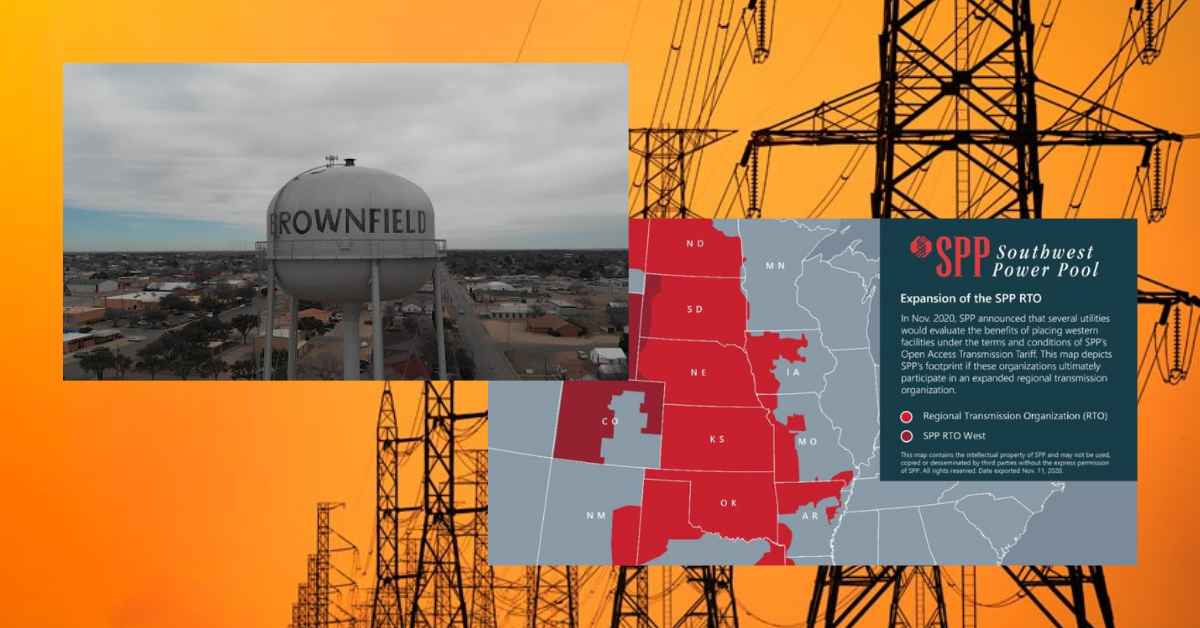
As most of State of Texas is reeling from the Electric Reliability Council of Texas (ERCOT) power disaster, the City of Brownfield has kept itself above water with the power situation. ERCOT represents 90% of the Texas’ electricity load, which means they manage the flow of electric power to more than 26 million Texas customers. Today five members of the ERCOT Board resigned their positions sighting that they do not live in the state.

Those that are resigning today after the ERCOT Board meeting are Sally Talberg, board chair; Peter Cramton, vice chair; Terry Bulger, finance and audit chair; and Raymond Hepper, human resources and governance committee chair, and Vanessa Anesetti-Parra, who is the market segment director for the independent retail electric provider market segment. Of course their resignations came on the heels of Texas Governor Greg Abbott stating on Tuesday Feb. 23, 2021, “When Texans were in desperate need of electricity, ERCOT failed to do its job and Texans were left shivering in their homes without power. ERCOT leadership made assurances that Texas’ power infrastructure was prepared for the winter storm, but those assurances proved to be devastatingly false. The lack of preparedness and transparency at ERCOT is unacceptable, and I welcome these resignations. The State of Texas will continue to investigate ERCOT and uncover the full picture of what went wrong, and we will ensure that the disastrous events of last week are never repeated.”
Throughout the past several days, Gov. Abbott has not held back his feelings about ERCOT. After his statement about the resignations, he had an interview Tuesday evening with KTRK in Houston and said, “This was a total failure by ERCOT… ERCOT stands for Electric Reliability Council of Texas, and they showed that they were not reliable.”

TownTalk spoke with Brownfield City Manager Jeff Davis last Thursday Feb. 18, 2021 in the midst of winter storm that caused the chaos and he stated, “We are going to be ok, simply because we are on a different grid and our power is managed by Southwest Power Pool (SPP). There are 14 states who represent SPP and they each were asked to help with the situation and they did.” However, rumors have begun across the state about higher energy cost coming to the consumers because of ERCOT’s failure to manage the grid the correct way. With that in mind Davis has put out a press release explaining the City of Brownfield’s position.
PRESS RELEASE
Last week’s pricing of wholesale power, specifically during the
Energy Reliability Council of Texas’ (ERCOT) Emergency
Energy Alert Level 3, was historic. The City of Brownfield is
not a member of ERCOT but is a member of the Southwest
Power Pool (SPP). The SPP is a balancing authority that is
federally regulated and contains members across 14 states. In
SPP a reserve margin must be maintained, due to a shortfall in
the reserve margin the City of Brownfield was asked to curtail a
percentage of its load last Tuesday February 16th for around 3
hours.We are aware of statewide media reports regarding unusually
high electric bills due to the winter storm. Due to how the City
of Brownfield’s fixed rates are structured and approved by the
Brownfield City Council, City of Brownfield customers are not
subject to the short-term fluctuations in electric rates referenced
by media reports in other regions of the state.
Thanks for everyone understanding!!!Jeff Davis, City Manager
A statement was also released from Barbara Sugg, the Southwest Power Pool president and chief executive officer
As a grid operator tasked with ensuring the reliable delivery of electricity to a 14-state region, Southwest Power Pool experienced the most operationally challenging week we’ve ever faced in our 80-year history last week. Record-low temperatures hit the entirety of our service territory and stayed low for days on end. The result was a simultaneous increase in electricity use at the same time power producers faced fuel-supply issues and equipment malfunctions: a perfect storm that stressed the bulk electric system to its limits. And, yet, with only two short-lived exceptions, SPP kept the lights on.
I am tremendously proud of the work our operations staff did to minimize the impacts of this storm to the nearly 18 million people who live in the SPP region. They worked around the clock, day after day, to plan for every next contingency and respond to every new emergency that developed. I’m also grateful to our partners in responding to this event: our member utilities, neighboring systems, and millions of people who voluntarily made sacrifices to conserve energy in the interest of the greater good. Because of our coordinated efforts, SPP had to temporarily interrupt electric service in our region only twice: once to lessen regional energy consumption by about 1.5% for 50 minutes Feb. 15 and again to lessen it by about 6.5% for a little more than three hours Feb. 16.
To those whose local utilities curtailed your power during either of those service interruptions, I want you to know that it was only as an absolute last resort that we took that step. Last week marked the first time SPP has ever had to direct controlled interruptions of service to our entire region, and we did so only after exhausting every other option, including bringing emergency generation online, importing power from neighboring regions, and more. We understand the critical role reliable electricity plays in your everyday lives, and that to go without it, especially in a prolonged period of extreme cold, puts lives and livelihoods at risk. Know that last week, the alternative would have been far worse, and had we not deliberately lessened our regional electricity use, we could have faced outages that were longer, more widespread, and more costly in terms of both lives and economics.
This week, temperatures are milder across our region. We’ve returned to normal operations, meaning there’s plenty of generating capacity available to both meet demand and satisfy our reserve requirements. And now our attention turns to learning what we can from last week’s historic event.
Though many heard of SPP for the first time just last week, we’ve been around since 1941. Our longevity and the success of our business model — which is built on the principles of collaboration and transparency — has been dependent on facilitating win-win solutions that benefit our region as a whole. We’ll apply the same approach to making the most of the opportunities that this crisis has given us.
SPP, like the rest of our industry, is now shifting from a posture of emergency response to one of recovery and preparation for the next challenge on the horizon. We’re committed to working together with our members and across our industry to learn from the events of last week and ensure we’re all equipped to manage future crises effectively. Just like we did last week as we worked to keep electricity flowing to millions of homes, farms and businesses, we rely on our partners to help us rise to the occasion.
So while the historic winter storm of February 2021 might be done, our work is not. To our member utilities, neighbors, regulators, elected officials, and the millions of people who call the SPP region home: We thank you for your trust in us, and we ask that you continue to partner with us to keep the lights on, today and in the future.
