


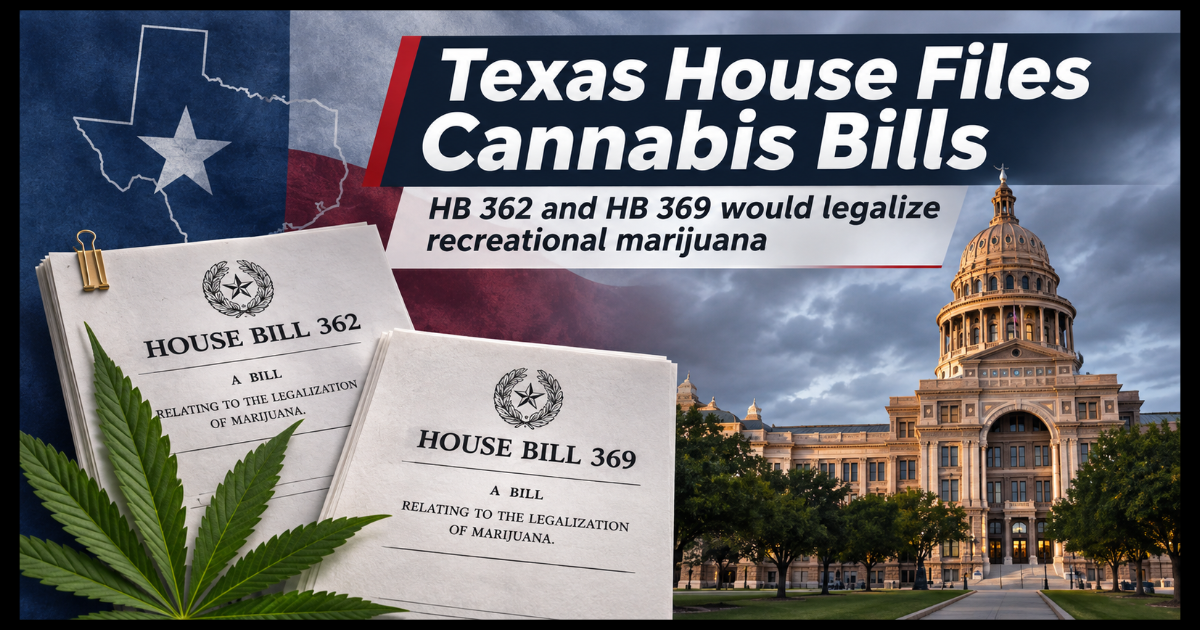
HB 362 and HB 369 would legalize recreational cannabis for adults 21 and older, establish a regulated marijuana industry, and generate tax revenue for education, veterans, and local governments.
Texas lawmakers have begun filing legislation ahead of the 90th Texas Legislative Session, and two newly filed bills could significantly change the state’s marijuana laws.
On Monday, November 9, 2026, state representatives and senators began prefiling legislation for the upcoming regular session, scheduled to convene January 12, 2027. Among the proposals are two House bills seeking to legalize recreational marijuana for adults and establish a statewide system for regulating and taxing cannabis sales.
House Bill 362, filed by Democratic State Representative John Bucy III of Austin, and House Bill 369, filed by Democratic State Representative Joe Moody of El Paso, are both titled the Texas Regulation of Cannabis Act.
The two proposals contain essentially identical provisions and would represent a significant departure from Texas’ existing marijuana restrictions. Both measures would authorize recreational cannabis use for adults 21 and older while creating a regulated commercial industry overseen by the Texas Department of Licensing and Regulation (TDLR).
Interestingly, the proposals come as several statewide public opinion polls have shown majority support among Texans for legalizing recreational marijuana, even though the issue continues to generate debate among state leaders.
What Would the Bills Allow?
Under HB 362 and HB 369, adults 21 years of age and older would be permitted to legally possess, use, and transport up to two ounces of cannabis. Of that amount, no more than 15 grams could be cannabis concentrate.
The legislation would also permit adults to transfer up to two ounces of cannabis to another adult without receiving payment, provided the transfer is not publicly advertised or promoted.
One of the more notable provisions would allow Texans to grow marijuana at home. Adults could cultivate up to 12 cannabis plants at their private residence for personal use. However, the plants would have to be grown in an enclosed, secured area that is not visible from a public location.
The bills would also allow residents to keep larger quantities of cannabis at home under specific storage requirements, including up to 10 ounces obtained from sources other than their homegrown plants. Cannabis exceeding two ounces would have to be secured in a locked container or restricted area.
Individuals participating in authorized cannabis activities would receive protections from arrest, prosecution, property forfeiture, and certain civil or professional penalties solely because of that lawful activity.
Texas Polls Show Majority Support for Marijuana Legalization
While recreational marijuana remains illegal under Texas law, statewide polling suggests that public attitudes toward legalization have changed significantly over the past decade.
A 2025 survey conducted by the University of Houston’s Hobby School of Public Affairs found that 62% of Texas adults supported legalizing the sale and use of recreational marijuana for individuals 21 years of age and older.
The survey, conducted January 13–20, 2025, also found that 79% supported legalizing medical marijuana with a prescription, while 69% supported decriminalizing marijuana possession for personal use.
The findings illustrate an important distinction in the marijuana debate. Some Texans support making marijuana available for medical purposes but remain opposed to recreational sales. Others favor eliminating criminal penalties for possession without necessarily supporting a commercial marijuana industry.
A separate statewide survey conducted by the University of Texas and the Texas Politics Project in April 2025 found that 51% of registered Texas voters supported legalizing marijuana possession for recreational purposes.
Of those surveyed, 35% supported legalizing possession of small amounts of marijuana for any purpose, while another 16% believed possession of any amount should be legal. Another 33% favored allowing marijuana for medical purposes only, while 15% believed marijuana possession should never be legal.
The findings were consistent with an earlier survey conducted by the Texas Lyceum in 2024, which reported that 60% of Texas adults supported legalizing marijuana use.
That represented a 14-percentage-point increase from the organization’s 2015 survey, when 46% supported legalization.
Taken together, the three surveys suggest that a substantial portion of the Texas population supports recreational marijuana legalization, although support varies depending on the question wording and the population surveyed.
However, the polling does not necessarily indicate support for every provision included in HB 362 and HB 369. Questions involving home cultivation, taxation, business licensing, and local government restrictions could produce different opinions.
The polling also does not determine how lawmakers will vote when the bills reach the legislative process.
Retail Sales and Licensing Requirements
Both proposals would establish a regulated marketplace for marijuana cultivation, processing, transportation, testing, and retail sales. TDLR would oversee licensing for cannabis growers, retail establishments, transportation businesses, and testing facilities. Businesses would be required to meet state licensing standards, follow security regulations, and comply with testing and labeling requirements.
Cannabis products would have to be sold in opaque, resealable, child-resistant packaging designed to prevent confusion with ordinary candy products. Retail establishments would be prohibited from selling cannabis to anyone younger than 21. Customers would be required to provide identification verifying their age. Under the proposed legislation, retail marijuana sales would be permitted only between 10 a.m. and 9 p.m. daily. Cannabis establishments would also be prohibited from employing anyone younger than 21.
Restrictions Would Remain in Place
Although the proposals would legalize recreational marijuana for adults, they would not eliminate restrictions on cannabis consumption and possession.
Driving while intoxicated by marijuana would remain illegal. The legislation would also prohibit consuming cannabis in vehicles traveling on public roads and in certain other transportation settings.
Public consumption would generally remain prohibited unless a local government specifically designates an area where cannabis use is permitted and restricts access to adults 21 and older.
Cannabis possession or consumption would continue to be prohibited at schools, childcare facilities, and correctional facilities.
The proposals also address private property rights, generally allowing property owners and managers to restrict cannabis activities on their premises, subject to certain protections for residential tenants.
Marijuana Sales Would Be Taxed, With Revenue Supporting Schools and Veterans
Another significant component of HB 362 and HB 369 involves taxation and how revenue generated from legal cannabis sales would be distributed.
Under the proposals, a 20% cannabis tax would be imposed on retail sales to consumers. Additionally, a 15% tax would apply to sales from cannabis growers to licensed cannabis establishments.
These taxes would be imposed in addition to the state’s existing sales tax.
Revenue collected from the cannabis-specific taxes would be distributed among several state programs.
Under the proposals, 50% would go to the Permanent School Fund, which supports public education in Texas.
Another 25% would be directed to the state’s Fund for Veterans’ Assistance, while 15% would support chemical dependency prevention, treatment, and rehabilitation programs.
The remaining 10% would go to a special account intended to help local governments with cannabis regulation and oversight.
The revenue provisions could make the legislation particularly relevant to public schools, veterans’ programs, and municipal governments across Texas.
However, the bills do not project how much revenue legalization could generate.
What Would This Mean for Local Governments?
For communities such as Brownfield, Meadow, and other municipalities throughout West Texas, the proposed legislation could have direct implications for city councils, local law enforcement, and business development.
Both measures would prohibit cities and counties from adopting ordinances that completely ban or unreasonably restrict cannabis businesses operating within the state’s regulatory framework.
However, local governments would retain the authority to establish certain regulations concerning business locations, hours of operation, the manner in which businesses operate, and the number of licensed cannabis businesses within their jurisdictions.
This would allow city councils to address zoning, business operations, and community concerns while operating under statewide guidelines.
Local governments would also have responsibilities involving public health inspections, recording complaints, and investigating or referring complaints involving cannabis establishments.
The legislation includes a mechanism for compensating qualifying cities and counties for certain regulatory enforcement expenses. Municipalities and counties with licensed cannabis establishments could apply to the Texas Comptroller for assistance payments, subject to available funding and the bill’s requirements.
For smaller municipalities, these provisions could raise discussions about zoning, public safety, enforcement costs, and potential economic development opportunities.
When Would the Law Take Effect?
If either bill passes the Texas Legislature and becomes law, the proposed effective date would be September 1, 2027.
However, the establishment of the commercial cannabis industry would occur over a longer timeline.
Under the proposals, the Texas Commission of Licensing and Regulation would have until July 1, 2028, to adopt the necessary regulations.
The Texas Department of Licensing and Regulation would then be required to begin licensing qualified cannabis growers, retailers, transporters, and testing facilities by November 1, 2028.
Consequently, even if the legislation becomes law in 2027, the framework for licensed commercial operations would not be fully established immediately.
What Happens Next?
Although HB 362 and HB 369 were filed separately by two different lawmakers, a review of the introduced legislation shows that the proposals contain the same substantive provisions.
Filing two similar bills does not mean the Legislature has approved either proposal. Both would still have to proceed through the legislative process, including committee consideration and votes in the House and Senate, before potentially reaching the governor.
Supporters of legalization generally argue that regulated sales could generate tax revenue, create business opportunities, and reduce criminal penalties associated with adult marijuana possession.
Opponents have raised concerns about marijuana impairment, public health, youth access, and the potential consequences of expanding the commercial cannabis industry.
The statewide polling adds another dimension to the debate. Although legislative approval remains uncertain, surveys conducted in 2024 and 2025 found that a majority of Texans surveyed favored some form of recreational marijuana legalization.
With bill filing now underway, marijuana legalization is once again an issue for consideration when the 90th Texas Legislature convenes in January.
For now, HB 362 and HB 369 represent proposed changes rather than changes in existing law. Their progress through the legislative process will determine whether Texas moves toward legal recreational marijuana sales and consumption.
