


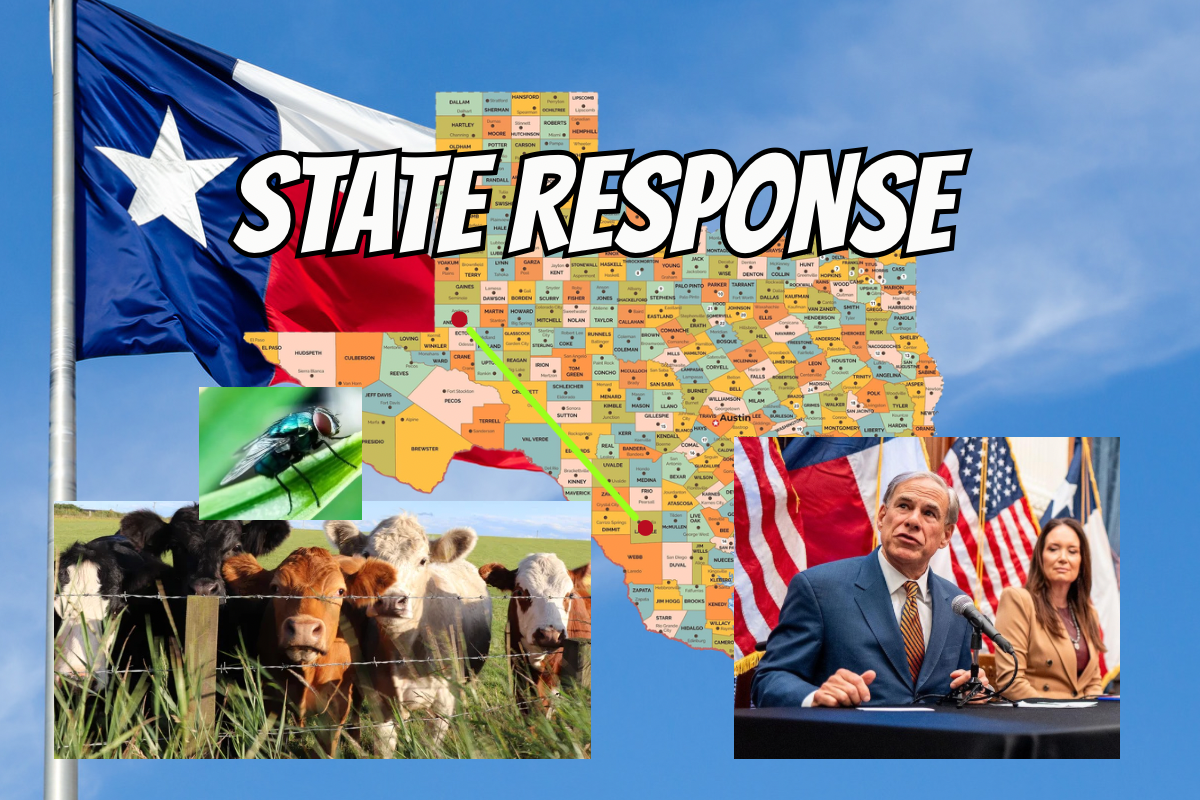
Governor Abbott activates Texas’ emergency response while USDA expands efforts to contain the flesh-eating parasite that threatens livestock, wildlife, pets, and the state’s agricultural economy.
AUSTIN — Texas and federal officials are intensifying efforts to combat the growing threat of the New World Screwworm (NWS) after two additional cases were confirmed in Texas, bringing the state’s total number of confirmed cases to four.
The latest cases were identified in a calf in La Salle County and a dog in Andrews County, according to the U.S. Department of Agriculture (USDA). Andrews is located approximately 70 miles southwest of Brownfield, making the latest detection particularly concerning for livestock producers across the South Plains.
The New World Screwworm is the larval stage of a parasitic fly that feeds on the living tissue of warm-blooded animals. Unlike common maggots that consume dead tissue, screwworm larvae invade open wounds and can cause severe injury or death if left untreated. Livestock, wildlife, pets, and even humans can be affected.
The discovery of additional cases prompted Governor Greg Abbott to activate the Texas State Emergency Operations Center (SOC) to Level II, an escalated response level designed to coordinate state resources and support efforts to contain and eradicate the pest.
“I have activated the full use of all state resources to respond to the New World Screwworm threat,” Abbott said. “The protection of our ranchers, livestock producers, deer breeders, and the Texas economy from this pest is a top priority. We have eradicated this pest before, and we will do it again in close cooperation with our federal partners.”
Abbott directed multiple state agencies to coordinate through the State Operations Center, including the Texas Animal Health Commission, Texas Department of Agriculture, Texas Parks and Wildlife Department, Texas A&M AgriLife Extension Service, Texas A&M Veterinary Medical Diagnostic Laboratory, and the Texas Department of State Health Services.
State officials are urging Texans to inspect animals daily for wounds and report any suspected cases immediately.
Meanwhile, the federal government announced additional steps to strengthen its response. U.S. Secretary of Agriculture Brooke Rollins named Texas businessman and agriculture leader John Bellinger as the USDA’s new Senior Advisor for New World Screwworm Preparedness.
Rollins said Bellinger’s Texas roots and extensive experience in agriculture, cattle production, food safety, and international meat exports make him uniquely qualified to assist in leading the response effort.
“John’s roots in Texas where New World Screwworm is at ground zero, and his private sector experience in the related food safety and cattle industries, will help the administration advance our response and protect U.S. livestock,” Rollins said.
Bellinger currently serves on the Texas A&M University System Board of Regents and has held leadership positions with numerous agricultural organizations, including the U.S. Meat Export Federation and the Southwest Meat Association. He was inducted into the U.S. Meat Industry Hall of Fame in 2022.
“USDA is responding in real time and building up long-term capabilities to push back New World Screwworm beyond our borders and past the Darien Gap,” Bellinger said. “I look forward to working with USDA and our state partners as we continue ramping up testing, detection, and deployment of our tools to reduce these flies’ populations.”
The USDA and cattle industry leaders have been preparing for the possibility of a screwworm outbreak since the pest reappeared in Mexico in late 2024. The parasite was eradicated from the United States in the 1960s through an innovative sterile fly program that involved releasing millions of sterile male flies to prevent reproduction.
Federal officials are once again relying on that strategy. The USDA is increasing sterile fly production at facilities outside the United States while planning construction of a large-scale sterile fly production facility in Texas.
University of Florida entomologist Edward Burgess, who studies screwworm populations, said additional cases are not unexpected and may partly be the result of increased surveillance efforts.
“When you are looking for something, you are more likely to see it,” Burgess said, noting that heightened awareness among ranchers and veterinarians is leading to more reports and inspections.
However, some Texas officials are expressing frustration with the pace of the federal response.
Texas Agriculture Commissioner Sid Miller has argued that the current strategy may not move quickly enough to prevent widespread impacts to the state’s livestock industry. Miller has advocated for additional control measures, including poison bait systems, though federal officials and other experts have expressed concerns about potential environmental impacts and effectiveness.
Miller also criticized federal policies regarding animal movement across the U.S.-Mexico border, noting that the infected dog in Andrews County had reportedly recently traveled from Mexico.
Canada has already responded to the outbreak by temporarily suspending imports of cattle, horses, and other livestock from Texas.
While the situation remains serious, officials emphasize that consumers should not be concerned about the safety of beef products. The parasite does not infest meat intended for consumption, and several approved treatments are available for infected livestock.
For ranchers and livestock owners across West Texas, including Terry County and surrounding areas, experts recommend closely monitoring animals for wounds, unusual behavior, or signs of infestation and reporting suspicious cases immediately.
Suspected livestock cases should be reported to the Texas Animal Health Commission at 1-800-550-8242. Suspected wildlife cases should be reported to Texas Parks and Wildlife Department at (512) 389-4505.
As state and federal agencies continue their coordinated response, officials remain hopeful that aggressive surveillance, containment efforts, and eventual sterile fly releases can prevent the New World Screwworm from gaining a foothold in Texas and threatening one of the state’s most important industries.
