


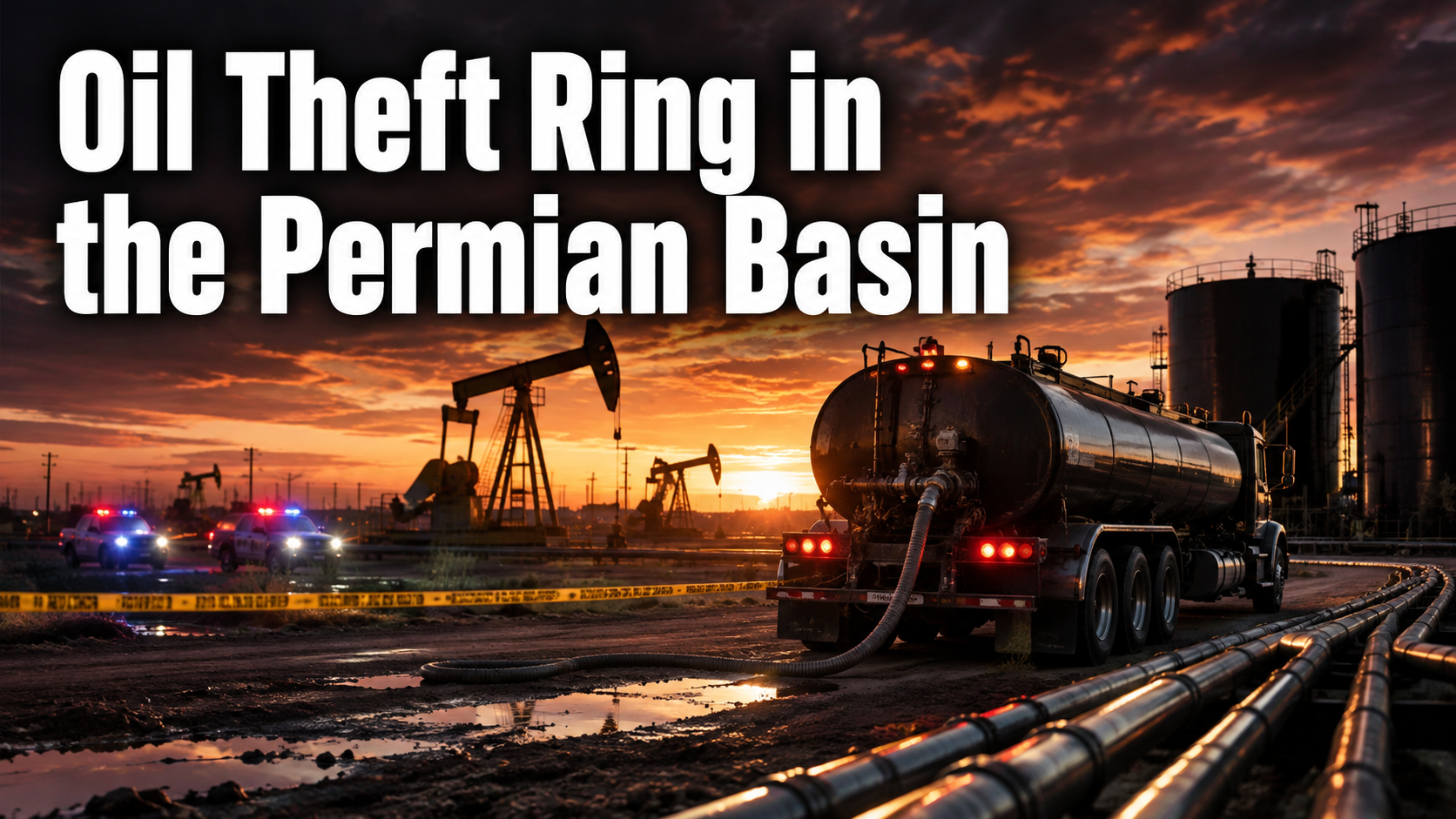
Federal prosecutors say organized groups have stolen and transported millions of dollars’ worth of crude oil across the New Mexico–Texas state line, highlighting a growing security and economic threat to the Permian Basin.
The theft of crude oil in West Texas and southeastern New Mexico is no longer being treated as a series of isolated property crimes.
Recent federal investigations have uncovered what authorities describe as sophisticated, coordinated operations involving oilfield employees, trucking companies, storage facilities, fraudulent paperwork and the interstate sale of stolen crude.
In one of the latest cases, a federal grand jury in Lubbock indicted 14 people from Texas and New Mexico for their alleged involvement in a large-scale oil theft conspiracy operating in the Permian Basin.
The indictment was returned April 8, 2026, and announced by the U.S. Attorney’s Office for the Northern District of Texas on April 22. Each defendant was charged with conspiracy to transport stolen property in interstate commerce. Several were also charged with interstate transportation, receipt, possession or sale of stolen property.
Federal prosecutors allege that members of the group stole crude oil from producers in eastern New Mexico and transported it into Texas for resale.
Some of the stolen oil was allegedly stored on land leased from the federal government. Prosecutors said one conspirator then sold the crude to other members of the operation at prices significantly below West Texas Intermediate, commonly known as WTI, which is a major benchmark used to price crude oil.
Those purchasing the oil allegedly knew it was stolen but transported it across the New Mexico–Texas border and resold it for a profit.
Fourteen Defendants Indicted
The Texas defendants named in the indictment are:
Randell Wayne Reid, 41, and James Darrell Reid, 65, both of Electra and identified as owners of Reidco Enterprises; and Christopher Frederick Harris, 22, of Seminole.
The defendants from Lovington, New Mexico, are Louis George Edgett, 68; Brenden Floyd Strickland, 25; Sixto Herrera-Estebane, 43; Gyardo Gonzalez, 47; Jesus Martin Hernandez-Borja, 51; Diana Marquez Rojo, 45; Jose Luis Rojo, 49; Jose Mario Rivas-Mendoza, 37; Miguel A. Soto, 41; Tavares Montrail Cole, 48; and Danny Dale Brown Jr., 42.
If convicted, each defendant could face up to five years in federal prison on the conspiracy charge. Those convicted of interstate transportation, receipt, possession or sale of stolen property could face up to 10 years in prison on each count.
The case was investigated by the Bureau of Land Management, FBI, Texas Department of Public Safety Criminal Investigations Division, Lea County Sheriff’s Office and Eddy County Sheriff’s Office.
An indictment contains allegations and is not evidence of guilt. Each defendant is presumed innocent unless proven guilty beyond a reasonable doubt.
Earlier Investigation Documented More Than 20 Theft Runs
The Lubbock indictment follows another major federal oil theft investigation announced in September 2025.
Federal authorities charged Maxwell Jensen, Thomas Rees, Christopher Ortega, German Ortiz-Santillano and Christian Jesus Contreras Varela in an alleged operation that stole crude oil from Plains All American Pipeline facilities in New Mexico, stored it at a Carlsbad yard and transported it into West Texas for resale.
According to the U.S. Attorney’s Office for the District of New Mexico, Bureau of Land Management agents began investigating the operation in June 2025.
Investigators used surveillance, vehicle-tracking devices and recorded conversations to document more than 20 suspected theft runs over approximately four weeks. Authorities said the group was siphoning hundreds of barrels of crude per day, with each load valued at tens of thousands of dollars.
Jensen was accused of coordinating the operation as its leader and organizer.
Rees allegedly managed a Carlsbad storage yard through his company, Hound Dog Energy, where stolen crude was received and sold. Authorities allege he also created fraudulent load tickets intended to make the oil appear legitimate.
Ortega allegedly directed drivers, prepared false documents and recruited additional participants. Ortiz-Santillano, who worked for Plains All American Pipeline, was accused of abusing his position to provide access to pipeline pigging stations.
Contreras Varela allegedly drove a vacuum truck to pipeline facilities, connected the truck to the system and removed the crude before returning to the storage yard.
The five men were charged with interstate transportation of stolen property and aiding and abetting. Contreras Varela was also charged with being an alien in possession of a firearm and ammunition. As with the more recent indictment, the charges are allegations, and the defendants are presumed innocent unless convicted.
Theft Reported Across the Industry
The two federal cases point to a larger problem affecting producers throughout the Permian Basin.
A September 2025 survey by the Federal Reserve Bank of Dallas found that 41% of participating oil and gas executives said their operations had been affected by oilfield theft during the previous year.
Among those who experienced theft, 61% reported that crude oil had been stolen. Other commonly stolen property included piping, valves, wiring and oilfield equipment.
Industry representatives have warned that the value of crude oil and equipment stolen in Texas could reach into the billions of dollars annually, although the precise financial impact remains difficult to establish.
Many thefts go undetected for extended periods or are difficult to prove because of the large number of wells, storage tanks, trucks and legitimate oilfield workers moving through the region each day.
The Permian Basin covers more than 86,000 square miles across West Texas and southeastern New Mexico. Its size, remote production sites and extensive network of rural roads can provide criminals with opportunities to enter a location, remove oil or equipment and leave without being seen.
Modern oil thieves may use vacuum trucks and other equipment that appears legitimate. Vehicles can be disguised as authorized oilfield or waste-hauling trucks, while fraudulent load tickets and sales documents may be used to introduce stolen crude into the legitimate marketplace.
License plates may also be covered or exchanged, and trucks can be switched during an operation to make the oil more difficult to track.
Texas Creates Petroleum Theft Task Force
Texas officials have responded by creating the State Taskforce on Petroleum Theft, known as STOPTHEFT.
The task force was established through Senate Bill 494 during the 89th Texas Legislature and is being coordinated by the Railroad Commission of Texas.
Its membership includes representatives from oil and gas producers, industry associations, the Texas Department of Public Safety, FBI and local law enforcement.
The group is studying existing petroleum theft laws, the effect of theft on state tax collections and the broader economic consequences for Texas. It is also developing recommendations for law enforcement training, industry security and possible legislative changes.
The Railroad Commission has said modern oilfield theft is increasingly organized and sophisticated. Officials have also raised concerns about connections to organized crime and foreign criminal networks.
The task force is expected to present recommendations to state leaders and the Texas Legislature as officials consider additional ways to protect producers, taxpayers and critical energy infrastructure.
More Than a Property Crime
Crude oil theft creates losses beyond the value of the product taken from a storage tank or pipeline.
Producers may face damaged equipment, interrupted operations, environmental risks, increased insurance and security costs and the loss of tax and royalty revenue.
Improper connections to pipelines or storage tanks can also create safety hazards for workers, nearby residents and emergency responders.
The recent federal cases demonstrate that organized oil theft can involve numerous participants performing different roles. One person may provide access to a pipeline, another may operate the truck, another may falsify documents, and others may store, purchase, transport or resell the stolen product.
Authorities say dismantling these networks will require cooperation among producers, pipeline operators, local sheriffs, state investigators and federal agencies on both sides of the Texas–New Mexico state line.
The message from recent investigations is clear: Oilfield theft in the Permian Basin has developed into a coordinated interstate crime problem with potentially serious consequences for one of the nation’s most important energy-producing regions.
