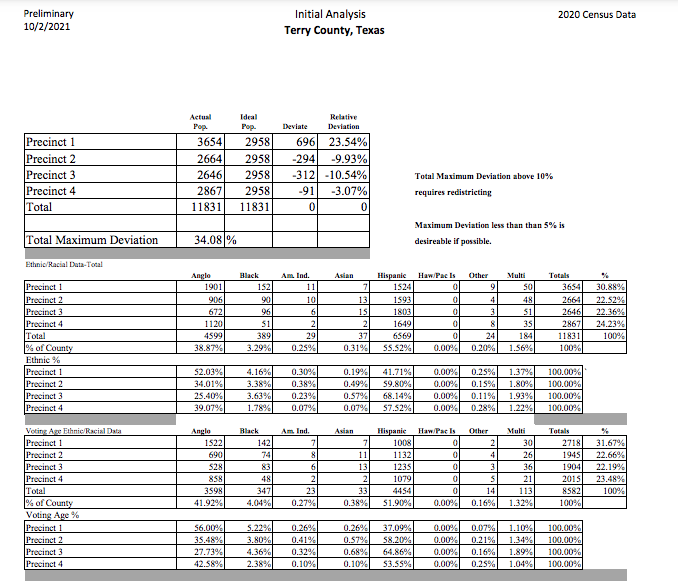
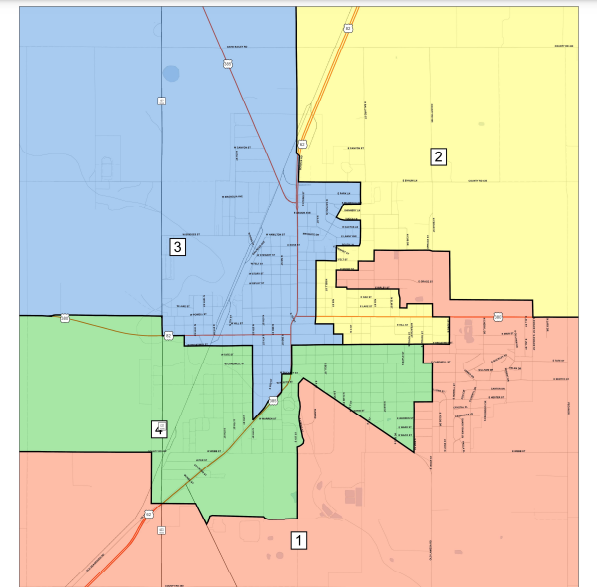
After the 2020 Census, the Terry County Commissioners will meet with Stan Reid of Allison, Bass, and Magee Attorneys at Law to discuss how the new population numbers will affect the precincts in Terry County.
This meeting will be at 9 a.m. in the Basement Meeting Room of the Terry County Courthouse on Thursday, October 22.
The General Overview from the Law Firm states:
“Following the Supreme Court decision in Avery v. Midland County, 390 U.S. 474; 88
S. Ct. 1114, 20 L. Ed. 2d 45 (1968), Texas Commissioners Courts have been required to make
a periodic assessment of their political boundaries to determine whether the boundaries retain
“one-person-one-vote” balance. This requirement is now carried forward by statutory
requirement in Article 42.001 of the Texas Election Code.
Therefore, following each federal census, each Texas County should conduct an
assessment of existing political boundaries. As a very general rule of thumb, any statistical
change of population between the 2010 and 2020 census more than 3%, plus or minus, will
indicate a potential need for reapportionment. Only in rare circumstances will a county
experiencing a population change in excess of 3% avoid the need for rather extensive
reapportionment of the county Commissioners Court precinct lines. However, any
assumption that a population change of less than 3% will not require reapportionment is ill
advised. Populations will shift within a county over time. Every County, even those with a
rather insignificant overall population change, should carefully examine actual population
demographics relative to their existing political lines to determine the need for
reapportionment.
It should be carefully noted that simple comparisons between the county population
of 2010 and 2020, or even a more sophisticated analysis of urban and rural areas of the county
might not reflect the true extent of population “change” each County has experienced over the
last ten years. “Change” may not directly correlate to “different” or “new” population. For
example, existing populations within a county move considerably within a ten-year span. The
movement of a single family a rural area to an urban area within the same county will impact
both categories, and where that move crosses political boundaries, may have a significant
impact on the obligation of that County to redistrict.
Efforts to balance road mileage, or to achieve other entirely practical adjustments of
county boundaries must be undertaken with great care to avoid unintended shifts of population
which will either exceed the required numerical balance, or will offend the Voting Rights Act.
With this general overview, the following sections of this Initial Assessment will
evaluate each layer of Terry County’s political boundaries and attempt to determine whether
or not the Commissioners Court should undertake reapportionment. Our assessment will
point out areas of potential conflict with state and federal law, and will also suggest areas that
may be considered for purposes of cost effectiveness and voter/resident convenience.“
In the General Housekeeping portion of the opinion, it was stated,
“Some attention should be given to “straightening” political boundaries into more
uniform shape. In some cases, certain election precincts may be altered to use a more
commonly understood or recognized physical boundary in lieu of a poorly identified or
recognized boundary. Public Law 94-171, which directed the Census Bureau to develop a
uniform mapping and demographic profiling approach for use by small personal computers,
required that all voter tabulation districts (VTDs) follow census block boundaries. In many
cases, county voting districts had been previously drawn in a manner that did not follow a
census block boundary. This required the State of Texas, acting in conjunction with the State
Data Center and the Texas Legislative Council, to move the actual voting district boundary to
coincide with a nearby census block boundary for tabulation purposes only. The resulting
VTD was no longer “actual,” but an approximation referred to as a “pseudo-voting district.”
Every reasonable effort has been made to conform the pseudo voting district to actual
VTD boundaries. However, due to the nature of the available data base, and the requirements
of Public Law 94-171, there may be occasions in which the pseudo voting districts, or the
resulting lines between commissioner’s court precincts, are different from those that actually
exist. Again, the use of the pseudo voting district was for tabulation purposes only, and any
apparent difference between actual and apparent political lines should be considered as
minimal. However, since all later census counts were undertaken upon the census blocks,
there could be a valid argument that a necessity to alter current election district boundaries to
match the census block format exists. Under these circumstances, new political lines will be
required to avoid conflict with census block lines that do not match current political area
definitions. While matching census blocks to actual political lines would not, in and of itself,
generally support a decision to reapportion under the circumstances that exist in Terry County,
there is a justifiable combination of factors that would support a reapportionment decision.
These factors would include:
- Redrawing election precincts to increase voter convenience.
- Consolidation of election precincts where practicable.
- Resizing election precincts to achieve greater efficiency.
- Harmonizing actual political lines with pseudo voting districts based upon census
blocks. - Redrawing all lines to achieve “one-person-one-vote” deviations of the smallest
possible percentage.”