


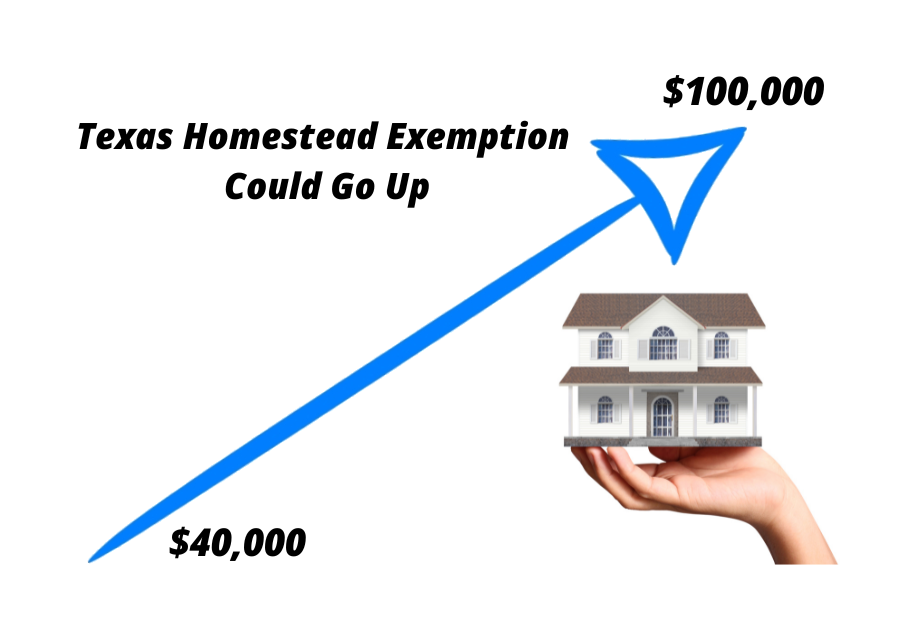
In today’s article on the 14 proposed amendments to the Texas Constitution, we’ll look at Proposition 4, which is about Property Tax Changes and State Education Funding. Here is how Proposition 4 is written on the ballot, “The constitutional amendment to authorize the legislature to establish a temporary limit on the maximum appraised value of real property other than a residence homestead for ad valorem tax purposes; to increase the amount of the exemption from ad valorem taxation by a school district applicable to residence homesteads from $40,000 to $100,000; to adjust the amount of the limitation on school district ad valorem taxes imposed on the residence homesteads of the elderly or disabled to reflect increases in certain exemption amounts; to except certain appropriations to pay for ad valorem tax relief from the constitutional limitation on the rate of growth of appropriations; and to authorize the legislature to provide for a four-year term of office for a member of the board of directors of certain appraisal districts.”

Breaking Down Proposition
If approved by the voters, Proposition 4 would increase the homestead tax exemption $100,000 from $40,000. The amendment will authorize the state legislature to limit the annual appraisal increase for non-homestead real properties. This limitation would be contingent upon the lesser of the property’s recent market value as evaluated by the appraisal entity or 120% (or a potentially higher percentage) of the previous tax year’s appraised value. The amendment enables the state legislature to introduce laws outlining supplementary eligibility prerequisites for this appraised value limitation, which would be effective either upon the law’s enactment or from January 1 following the initial year of property ownership, depending on the later date. This subsection of the amendment would expire on December 31, 2026.[2]
If approved, the amendment will require the state legislature to incorporate a reduction in the limitation on property taxes for elderly or disabled homeowners with homesteads. This reduction would equate to $15,000 multiplied by the 2022 tax rate designated for general elementary and secondary public school objectives. Commencing from the 2023 tax year, if there are changes in the general school district residence homestead exemption for various categories of residents, the legislature must implement reductions in the limitation amount for those homesteads subject to the prior year’s limitation. The reduction should be proportional to the changed exemption and the applicable tax rate for public school purposes. Proposition 4 would authorize the state legislature to enact laws concerning the governing board of an appraisal entity in counties with populations exceeding 75,000. The amendment would exclude state tax revenue appropriations for ad valorem tax payments from the constitutional appropriations limit.

Background to Proposition 4
After the state legislature did not pass a property tax amendment during the 2023 regular legislative session. Texas Gov. Greg Abbott (R) called for a special session on May 29 to address property taxes, however after nine different amendments were proposed none were passed. Gov. Abbot then called for a second special legislative session on June 27 where Proposition 4 was introduced as House Joint Resolution 2 on July 10, 2023. It passed in the House by a vote of 132-5 with 13 absent on July 13. HJR 2 passed in the Senate on the same day by a vote of 31-0.
Once HJR 2 passed, Gov. Greg Abbott (R) said, “The Texas House and Senate fulfilled our promise with an agreement that delivers a comprehensive, long-lasting solution to increasingly burdensome property tax bills. I thank my partners in the Texas Legislature for coming together to honor the best interests of hardworking Texans who want to own their property—not rent it from the government.”
Voters in Texas have in the past approved an increase on the homestead property tax exemption. In fact as recently as May 2022, Texas voters approved an an amendment to increase the homestead exemption from $25,000 to $40,000. Also in 2015, Texas voters approved Proposition 1, which increased the homestead exemption from $15,000 to $25,000. Prior to that, Texas voters had last increased the exemption in 1997 with the passage of Proposition 1, which increased the homestead exemption from $5,000 to $15,000. They were all approved with at least 84% of the vote.
Other Proposition 4 information
Homestead tax exemption increase
The amendment would increase the homestead tax exemption from $40,000 to $100,000. The increased exemption would apply to the tax year beginning on or after January 1, 2023. The homestead tax exemption was last increased in May 2022 from $25,000 to $40,000.
Non-homestead real property appraisal limit
The amendment would also authorize the state legislature to limit the annual appraisal increase on non-homestead real property to the lesser value between the property’s most recent market value as determined by the appraisal entity or 120% (or a higher percentage) of the appraised value from the previous tax year The amendment also authorizes the state law to pass laws prescribing additional eligibility requirements for the limitation on appraised values. The appraisal limit would apply to either the effective date of the law imposing the limitation or January 1 of the tax year following the first tax year of ownership, whichever is later. This subsection of the amendment would expire on December 31, 2026.
Property tax limits on homesteads owned by elderly or disabled residents
The amendment requires the state legislature to provide for a reduction in the amount of the limitation on property taxes on homesteads owned by elderly or disabled residents in an amount equal to $15,000 multiplied by the 2022 tax rate for general elementary and secondary public school purposes. Beginning with the 2023 tax year, if the general school district residence homestead exemption amount for a married or unmarried adult (including those living alone), or the exemption amount for a person who is elderly or disabled, is increased in any tax year, the legislature would be required to implement a reduction for that year and subsequent years in the limitation amount provided by the tax ceiling for residence homesteads that were subject to the limitation in the preceding tax year. The amendment requires the reduction to be equal to the increased exemption amount multiplied by the tax rate for general elementary and secondary public school purposes applicable to the residence homestead for the tax year in which the exemption amount is increased. This would apply to tax years beginning on or after January 1, 2023.

Excluding additional state education funding from appropriations limit
The amendment would also exclude the appropriations of state tax revenue for the purposes of paying for ad valorem tax from the constitution appropriations limit.
Appraisal board governance
The amendment would also authorize the state legislature to pass laws related to the governing board of an appraisal entity in a county with a population of 75,000 or more.
A “yes” vote supports amending the state constitution to:
- increase the homestead tax exemption from $40,000 to $100,000;
- authorize the state legislature to limit the annual appraisal increase on non-homestead real property;
- exclude appropriations made to increase state education funding from the state appropriations limit; and
- authorize the state legislature to provide for four-year terms for members of the governing body of an appraisal entity in counties with a population of 75,000 or more.
A “no” vote opposes this constitutional amendment to increase the homestead property tax exemption; authorize the state legislature to limit the annual appraisal of non-homestead real property; and exclude increased state education funding from the appropriations limit.
Disclaimer: TownTalk does not support or endorse a “YES” or a “NO” to these propositions. The information provided in this article is for informational purposes only.
