


Should Texas Grow West? A Look at Annexing Eastern New Mexico
Every now and then, a conversation pops up that makes you stop, scratch your head, and say, “Well… that’s interesting.”
Recently, one of those ideas made its way back into the discussion: What if Texas annexed parts of eastern New Mexico?
Now, before anyone starts drawing new maps or loading up wagons, let’s be clear—this isn’t happening anytime soon. But it’s the kind of “what if” that’s worth exploring, if for no other reason than it sparks conversation about identity, economics, and just how big Texas really ought to be.
And let’s be honest—Texans have never exactly been shy about thinking big.
A Conversation That’s Getting Real
Now, before we write this whole idea off as just coffee shop talk or social media chatter, it’s worth noting—this conversation has actually made its way into serious discussions at the state level.
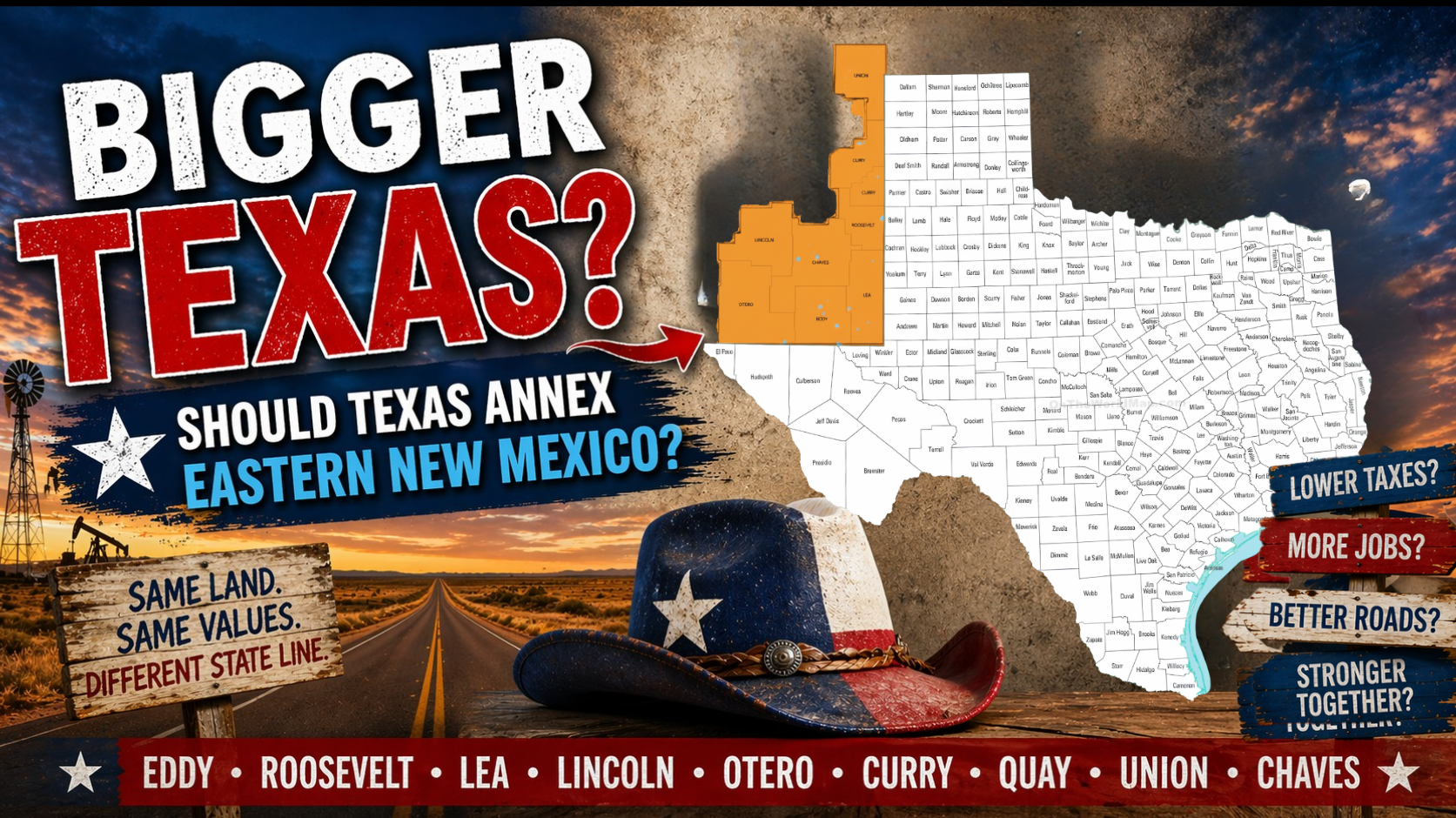
The Texas Governmental Oversight Committee is currently exploring whether to annex parts of eastern New Mexico, specifically Lea, Roosevelt, and Eddy counties. House Speaker and Lubbock State Representative Dustin Burrows has directed lawmakers to study the proposal ahead of the upcoming legislative session.
That alone shifts this idea from “what if” to “well… hold on a second.”
According to Burrows, the discussion isn’t just about geography—it’s about culture, shared values, and opportunity. And perhaps most interesting of all, Texas leaders say this idea didn’t even originate on this side of the state line.
“We didn’t initiate this,” said Lubbock State Representative Carl Tepper, a member of the Governmental Oversight Committee. “State representatives from New Mexico initiated bills to remove themselves—not to become their own state—but to become part of West Texas.”
Let that sink in for a moment.
This isn’t Texas trying to grow just for the sake of growing. At least according to those involved, it’s a response to interest coming from communities that already feel more connected to West Texas than to Santa Fe.
And if that’s the case, it raises an even bigger question:
What happens when state lines no longer reflect the identity of the people living near them?
A Little History (Because This Isn’t a New Idea)
Believe it or not, Texas once laid claim to a whole lot more land than it has today.
Back in the days of the Republic of Texas (1836–1845), Texas claimed territory that stretched far beyond its current borders—well into what is now New Mexico, Colorado, Kansas, and even Wyoming. That claim was rooted in the belief that the Rio Grande was the western boundary of Texas, not just down south, but all the way north.
That didn’t sit too well with the folks already living in those areas—or with the federal government. It eventually led to disputes that were settled by the Compromise of 1850, where Texas gave up those western claims in exchange for $10 million (which, at the time, was a pretty good deal).
So technically speaking, parts of eastern New Mexico were once “claimed” by Texas. Whether they ever felt like Texas is another story entirely.
Why Eastern New Mexico?
The counties in question—Eddy, Roosevelt, Lea, Lincoln, Otero, Curry, Chavez, Union, and Quay—sit right along the Texas border. If you’ve ever driven through that region, you know something right away:
It looks a whole lot like West Texas.
Flat stretches, oil and gas activity, agriculture, windmills, pickup trucks, and a strong independent streak. In many ways, culturally and economically, eastern New Mexico has more in common with places like Brownfield, Lubbock, or Midland than it does with Santa Fe or Albuquerque.
So the argument goes: if it walks like West Texas and talks like West Texas… should it be Texas?
The Case For Annexation
Let’s start with the arguments that might make a Texan nod in agreement.
1. Economic Alignment
Eastern New Mexico’s economy is heavily tied to oil, gas, and agriculture—industries that Texas understands very well. Supporters of annexation might argue that being part of Texas could mean:
- Fewer regulatory hurdles
- A more business-friendly environment
- Greater economic growth tied to Texas markets
And let’s not ignore the obvious: Texas has no state income tax. That alone might get some folks’ attention.
2. Cultural Similarity
This one’s less about policy and more about people.
From high school football to farming and ranching traditions, eastern New Mexico shares a lifestyle that feels very familiar to West Texans. Small-town values, strong faith communities, and a “take care of your neighbor” mindset run deep on both sides of the state line.
In short, it wouldn’t feel like a huge culture shock.
3. Infrastructure & Influence
Texas is known for investing heavily in roads, energy infrastructure, and economic development. Annexation proponents might argue that these counties could benefit from:
- Expanded infrastructure funding
- Access to Texas’s larger economy
- Increased political influence through a bigger state system
The Case Against Annexation
Now, before we go planting Texas flags west of Hobbs, let’s talk reality.
1. It’s Not That Simple
States can’t just absorb counties from another state because it sounds like a good idea.
It would require:
- Approval from the New Mexico Legislature
- Approval from the Texas Legislature
- Approval from the U.S. Congress
In other words… don’t hold your breath.
2. Identity Matters
New Mexicans are proud of being New Mexicans—just like Texans are proud of being Texans.
Eastern New Mexico may share similarities with West Texas, but it also has its own identity, history, and heritage. From unique cultural influences to state traditions, there’s more there than meets the eye.
You can’t just swap out a license plate and expect everyone to be on board.
3. Winners and Losers
Every major change comes with trade-offs.
- Some residents might benefit from lower taxes
- Others could lose access to certain state programs
- Public education systems, healthcare funding, and local governance would all be affected
There’s no guarantee everyone comes out ahead.
4. The “Bigger Texas” Question
Let’s ask the real question:
Does Texas need to be any bigger?
We’re already the second-largest state in the country. At some point, you’ve got to ask if expansion is about practicality… or just pride.
(Although, let’s be honest—Texans have never had a problem with a little pride.)
A Little Humor Along the Way
If this ever did happen, you can imagine how it would go:
- New Mexico would say, “You can have the land, but you’re not getting our green chile.”
- Texas would respond, “That’s fine—we’ve got brisket.”
- And somewhere in the middle, folks would argue over whether it’s “Christmas style” or “barbecue sauce.”
There’d probably be debates over high school football divisions, county names, and whether Whataburger needs to be built on every corner (answer: yes).
And you just know someone would try to rename a town “West-West Texas.”
So… Should It Happen?
In reality, annexing eastern New Mexico counties into Texas is more of a thought experiment than a policy proposal.
But it does raise important questions:
- What defines a state—its borders or its people?
- How much should economics drive identity?
- And where do we draw the line between shared culture and state pride?
At the end of the day, state lines are more than just marks on a map. They represent history, governance, and a sense of belonging.
Final Thoughts
Texas has always had a reputation for thinking big. From its days as an independent republic to its role as an economic powerhouse today, it’s a state that doesn’t shy away from bold ideas. But sometimes, the value of an idea isn’t in whether it happens—it’s in the conversation it creates.
And if nothing else, this one reminds us just how unique—and how connected—our communities really are across the South Plains and beyond. Because whether you’re in Brownfield, Hobbs, Clovis, or Roswell…
You’re still part of a region that shares the same skies, the same struggles, and the same hope for the future.
And that might matter more than any line on a map.
